
Ethiopia
Featured Documents
Overview
In 2025, the ES/NFI Cluster significantly scaled up its operations, driven by strengthened partner coordination and improved pipeline mobilization. Large‑scale distributions formed the backbone of the response, delivering essential ES/NFI kits, household items, and emergency shelter materials across regions affected by conflict, displacement, and natural hazards. By year’s end, the cluster had reached approximately 493,000 people, 24% of the annual target, with an additional 7% supported through ongoing and planned activities. However, funding shortages remained the primary reason why 1.5 million people (69% of the target) could not be reached, despite robust coordination and partner engagement. Coverage varied across regions: Afar achieved nearly half its target, while the Somali Region recorded the lowest coverage due to the scale of needs relative to available resources. Oromia contributed the largest share of people reached nationally, highlighting significant differences in operational scale and prioritization under constrained funding conditions.
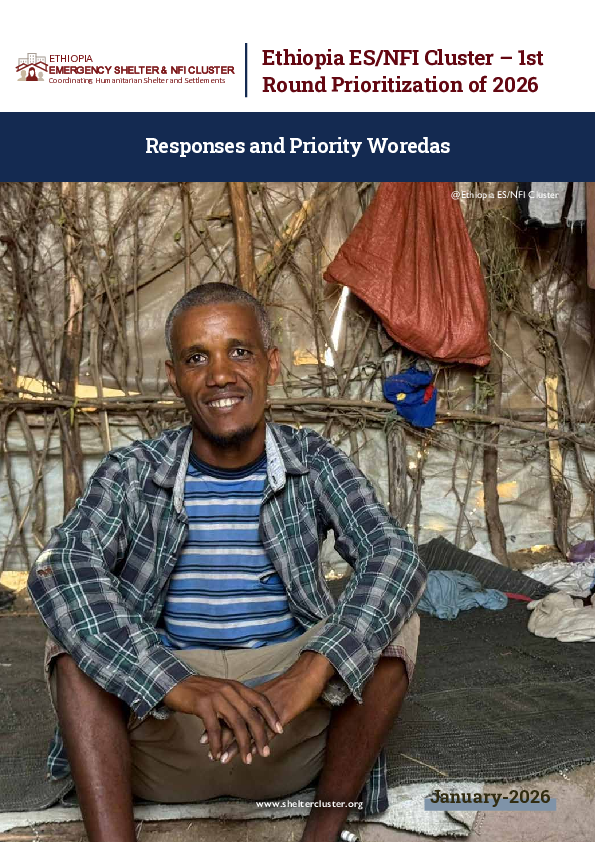
Funding limitations continued to be the main barrier to expanding lifesaving ES/NFI support. Total funding reached USD 32.6 million, with OCHA‑EHF contributing 44.3%, followed by FCDO, the US Embassy, the IOM Common Pipeline, ICRC, ECHO, and four additional donors, together making up 96.3% of available resources. Despite this support, the cluster faced a 67% funding gap, reducing its capacity to scale up operations, pre‑position supplies, and respond to newly emerging needs. The common shelter pipeline complemented partner‑led responses by supporting around 35,000 people through nine partners with standardized, quality‑assured items that enhanced predictability and response speed. As the cluster moves forward, it has already published the 2026 first‑round prioritization, ensuring early targeting of the most urgent and underserved needs while underscoring the continued importance of expanded donor support to sustain and scale assistance.